
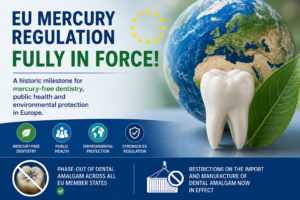
1 July 2026 marks the full entry into force of the revised EU Mercury Regulation, completing the phase-out of dental amalgam across all European Union Member States. At the same time, new restrictions on the import and manufacture of dental amalgam have taken effect, representing a major milestone for public health, environmental protection, and the global transition toward mercury-free healthcare.
Final Transitioning Countries Complete Implementation
The final steps in the EU-wide phase-out have now been completed by countries that had been granted temporary derogations (Czechia and Slovenia) or required additional policy adjustments (Croatia).
In 🇨🇿 Czechia, the full reimbursement of non-layered composites was already introduced in January 2026, and the ban now consolidates this transition in practice.
In 🇸🇮 Slovenia, public health insurance now reimburses composite fillings without differentiation across all age groups. This marks a significant step toward equitable access to mercury-free restorative materials.
In 🇭🇷 Croatia, the Ministry of Health introduced a new reimbursement framework for restorative care by 1 July 2026. Under the revised scheme:
• Composite fillings are covered for vulnerable population groups, including children, adolescents, pregnant and breastfeeding women.
• Glass ionomer cements are covered for the general population as standard restorative materials.
These changes demonstrate how public reimbursement systems can successfully integrate glass ionomer cements and composite restorative materials. Both materials are considered essential medicines by the World Health Organization (WHO) and their coverage is an integrated part of the Global Oral Health Action Plan 2023–2030 to achieve universal health coverage (UHC) and strengthen the prevention and control of noncommunicable diseases (NCDs).
Import and Manufacturing Restrictions in Place
Beyond the clinical phase-out, the new restrictions on the manufacture and import of dental amalgam are expected to strengthen implementation across the EU. The Directorate-General for Taxation and Customs Union introduced new requirements for the border control and will monitor imports from third countries for the exceptional use of dental amalgam, while the manufacture of dental amalgam has already ceased within the Union.
A Turning Point for Oral Health Policy
The full entry into force of the EU Mercury Regulation is more than a technical regulatory update. It is a clear signal that public health systems can transition toward safer, more sustainable, and environmentally responsible models of care.
The European experience may also serve as a model for countries worldwide that are working toward fulfilling their obligations under the Minamata Convention and expanding mercury-free oral healthcare.
Explore our updated overview of how the amalgam phase-out is being implemented in public programs across the EU: 👉 https://environmentalmedicine.eu/lessons-learned-form-countries-phasing-out-dental-amalgam-in-public-programs
A Domino Effect in the Region
On the same day that the EU Mercury Regulation fully entered into force, the phase-out of dental amalgam also became effective in the EFTA states — 🇳🇴 Norway, 🇱🇮 Liechtenstein, and 🇮🇸 Iceland. In practice, this primarily affects Iceland, as Norway has already prohibited dental amalgam since 2008, and Liechtenstein has restricted its use since 2015 to cases where mercury-free alternatives cannot be preferred for medical reasons. 👉 https://www.efta.int/eea-lex/32024r1849
EU candidate countries such as 🇲🇪 Montenegro, 🇦🇱 Albania, 🇲🇰 North Macedonia, and 🇷🇸 Serbia are also expected to follow in the coming years through the Stabilisation and Association Process (SAP), which increasingly aligns their environmental and public health legislation with EU standards.
Europe’s “Island of Mercury”: 🇬🇧 UK
Ten years after Brexit, dental amalgam remains widely used in the United Kingdom, accounting for an estimated 40% of all fillings placed.
🇯🇪 Northern Ireland, which remains aligned with certain EU rules under the Windsor Framework, has legally committed to phasing out amalgam by 2034. 🏴 England, 🏴 Scotland, and 🏴 Wales are expected to follow with the necessary regulatory steps in line with their commitments under the Minamata Convention on Mercury.
However, given the examples from the rest of Europe, there is a strong case for accelerating this transition. Replacing amalgam in the NHS with glass ionomer cements and composite restorations would not only align the UK more closely with Europe, but also with WHO recommendations for modern, mercury-free oral health coverage by 2030.