

15 December 2025, NEW YORK CITY – A hard-won political declaration on noncommunicable diseases, supported by the vast majority of UN member states, failed to be formally adopted during the high-level meeting of the General Assembly. The United States blocked its adoption by consensus so that the draft, which highlights the harm from chemicals, was referred back to the General Assembly for discussion and vote today.
The target of the political resolution is to reaffirm the commitment to reduce by one third premature mortality from noncommunicable diseases by 2030 through the prevention and control of noncommunicable diseases, and the promotion of mental health and well-being.
By 2030, 150 million fewer tobacco users should be achieved, 150 million more people with hypertension under control and 150 million more people with access to mental health care. The declaration for example suggest to sharpen regulatory focus on e-cigarettes, novel tobacco products, unhealthy food marketing to children, front-of-pack labelling, and the elimination of trans fats.
The draft was supported by the Group of 77, including China, the largest bloc in the United Nations, representing 130 emerging economies; the Gulf Cooperation Council, representing a powerful group of oil-producing states in the Middle East; the Caricom alliance of Caribbean states; the European Union; the Pacific Island states; and the Philippines, speaking on behalf of the Association of Southeast Asian Nations (ASEAN).
US Health and Human Services Secretary Robert F Kennedy Jr charged that the UN draft went too far in recommending measures like taxes on unhealthy products – while not going far enough on other chronic disease related issues. The US veto means that the draft had to be submitted to a formal member state vote during the 80th session of the UN General Assembly, and had been adopted with a vast majority today.
While the declaration recognizes that the main modifiable risk factors of noncommunicable diseases are tobacco use, harmful use of alcohol, unhealthy diets, physical inactivity and air pollution, it expands environmental determinants to clean cooking, lead exposure, and hazardous chemicals, which are largely preventable and require cross-sectoral actions.
Ligia Noronha, UN Assistant Secretary-General and Head of UNEP, New York Office, highlighted the need to focus on the pursuing of planetary health for human health and the consideration of increasing health care costs ” Environmental and human health are inseparable. We can see this clearly in today’s world. Air pollution, we have 7 million deaths per year, antimicrobial resistance, 4.7 million deaths in 2021, with a toll growing, exposure to chemicals around 2 million deaths per year.”
“Multilateral environmental agreements which address chemicals and waste, climate desertification, land degradation, and drought and biodiversity are the arenas for making change happen… The Global Framework for Chemicals adopted in late 2023 is one of the primary routes to a planet free of harm from chemicals and waste and is now backed by the recently established Intergovernmental Science Policy Panel on Chemicals, Waste and Pollution.”
The European Network for Environmental Medicine was an accredited participant of the 4th UN High Level Meeting and advocated for the recognition of harm from chemicals as 6th risk factor for NCDs before the next High Level Meeting takes place in 2031.
EnvMed stated “The latest calculation of the burden of disease is considered an underestimation due to limited data and scientific evidence on the health impacts of many chemicals. A significant portion of these deaths were attributed to lead exposure and related cardiovascular diseases. Adding in new data and data on other chemicals, the burden of disease will likely be comparable to air pollution and smoking.”
The Text now recognises harm from Chemicals as follows:
„We(…) encourage within national and, where relevant, regional contexts, as appropriate, legislation and regulation, policies and actions to(…) address the environmental determinants of health, including the exposure to air pollution by(…) reducing the exposure, especially of children, to lead and hazardous and synthetic chemicals…“
Further Information:
WHO Press Release: https://www.who.int/news/item/16-12-2025-world-leaders-adopt-a-historic-global-declaration-on-noncommunicable-diseases-and-mental-health
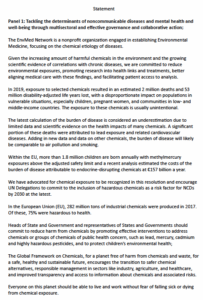
Full EnvMed statement for the panel: Tackling the determinants of NCDs and mental health and well-being through multisectoral and effective governance and collaborative action.
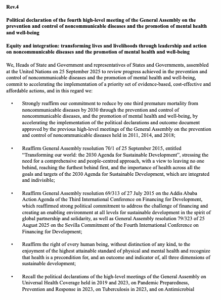
Political declaration of the fourth high-level meeting of the General Assembly on the prevention and control of noncommunicable diseases and the promotion of mental health and well-being
UN Declaration on Noncommunicable Diseases Fails to Win Approval After US Foils Consensus